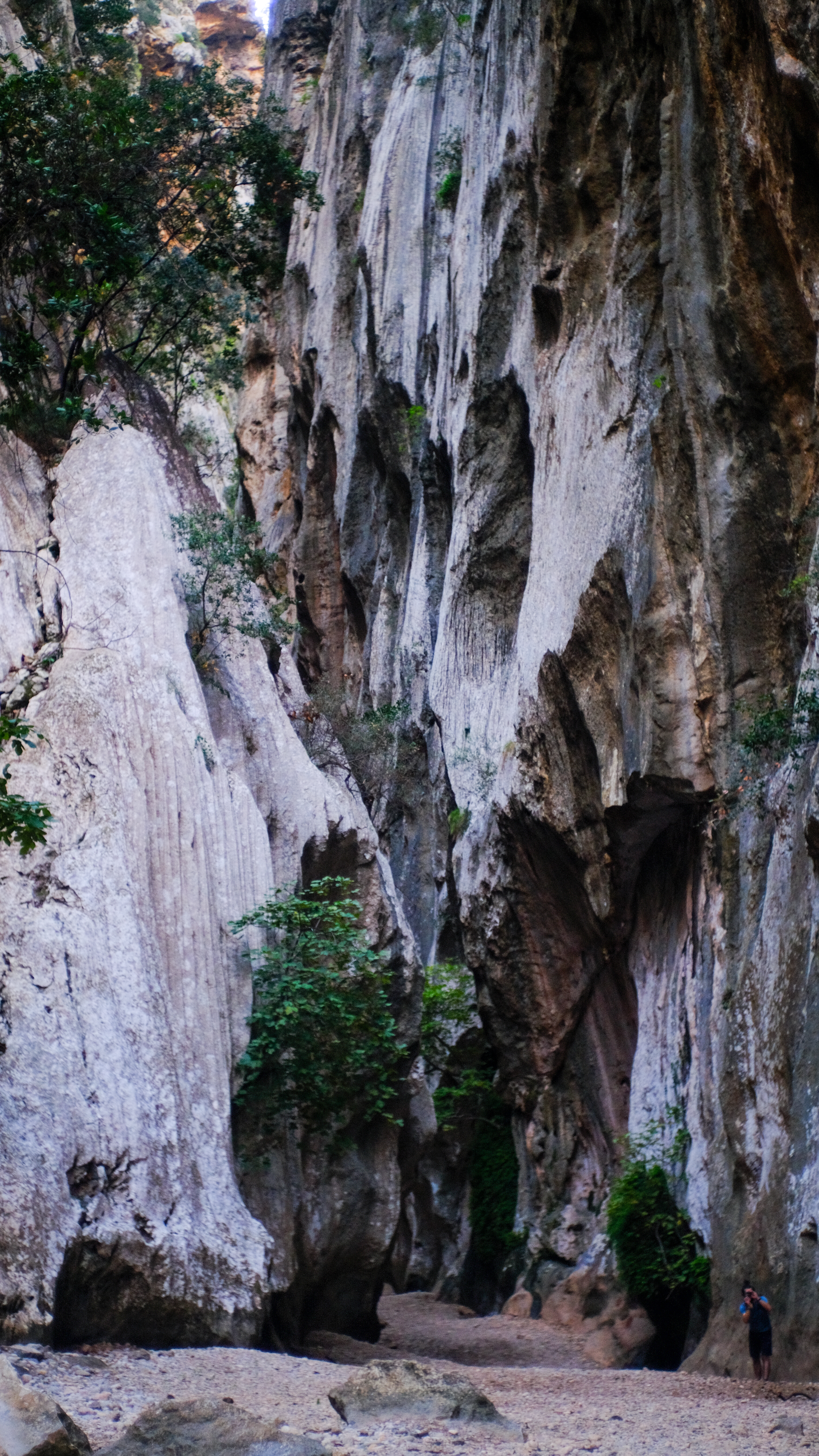
In what felt to be a universal conspiring of convergence, I was able to join the MonViso Institute in the midst of their weeklong, immersive Systemic Design trip along the north of Mallorca. There to celebrate the wedding of my dear friends Javi and Emma, it seemed fortuitous that not only would the institute from which I’ve drawn inspiration be on the island at the same time, but passing within a stone’s throw of the very town that I was based for my time there. I was able to join for a few days’ exploration along the Po River in northern Italy last year, hiking from a monastery to the sea, via the outrageous Torrent d’ Pareis gorge. The route promised boulders, likely swims, and no shortage of moments for reflective processing felt a worthy continuation of insight into the MonViso Institute’s process.
With only 24 hours to share among a deeply thoughtful, intensively-focused group on a multi-modal journey across the Tramuntana, I hadn’t a moment to waste.

A yearslong theme that was amplified in last year’s foray has been a rewiring of my relationship to water; not simply as a means of resource management, but in connecting to the spirit of what ultimately is the catalyst for all life as we know it1. That was my focus heading in, which felt fitting to embrace at the end of an extremely hot summer, with the fall rains proving elusive to turn the season. To be like water is to move differently, respond in reality, change form when circumstances present, and access (if lucky) a state of flow.
1) I know that the framing of water in this way can feel a little…esoteric, but give it a try. Find your closest moving body of water, sit there in silence for a bit, and just listen. See what happens.

These considerations came to mind as I climbed with the sunrise from Caimari to Col de Sa Batalla, one of the island’s iconic cycling ascents, until I arrived in Lluc with the sun casting a glow on the plants abuzz within the sanctuary walls. Getting to see familiar faces in new places is always a pleasure, especially when they are of friends and teachers. So as I rounded the corner of the entry, I was happy to see Tobias, Folef, and Christian from the Po River excursion, as well as making a tangible connection from a digital one with Michael Grimm. In the midst of their multi-month course, this trip is just one element in the program based around regenerative system analysis and design.
With just enough time to change out of my cycling gear and down an espresso, a round of introductions was made. From the jump, I felt welcomed into their group, all in the midst of some big decision-making forays and conversations happening just prior. This global crew presented a geographic convergence, spanning Korea to Australia, Chile to Switzerland, and now with a Yankee in the fray for the come what may.
Today’s central thread: checkpoints. How can we identify them, and allow for our experience to unfold until they are met, without constant reassessment?
When we set informed and thoughtful checkpoints, we provide a spaciousness for unfolding.
Put simply by Tobias, “If we are left questioning each moment where we are heading, then we never arrive anywhere.” As a chronic over-analyzer and hyper-optimizer, this is the kind of nugget that is both incisive and comforting. Throw in defining uncertainty and its acceptance to a (tolerable) degree, an accounting of personal and group-wide experience, understanding the framework for hazard mitigation and back-ups in place, and room for intuition through it all, the day’s plan with dynamic checkpoints came into view.
Like water through a landscape, conditions and inflection points shape the journey: from sky to earth, through cracks into the ground, collected in a puddle, or rushing along with a watershed torrent. Water doesn’t know what awaits the next bend, but moves within the contours of its surroundings.
At a certain point, though, water’s journey to the sea can’t happen in conversation, and the flow must go on.

“If we are left questioning each moment where we are heading, then we never arrive anywhere.”
-Tobias Luthe

Mere minutes into our jaunt, as we stepped like water flowing downhill towards the drainage we sought, we met our first literal roadblock. Effectively a sign condemning the trespass onto private land, with the added note about ongoing hunting. As a solo or duo going casually? Probably fine. In a formalized context with ten people?
This unintended checkpoint gives space for discernment to say, “find another way.”

“There is no good or bad.”
So we go up, with a buoyancy that comes from withholding judgment on whether something is good or bad (better summarized by the story of “maybes” of a Chinese farmer). And so, we found ourselves climbing back uphill, in a very non-aqua fashion physically, but flowing in spirit. We met the road, which provided a stark contrast to the oak forest preceding and tall grass awaiting: loud, hard, dangerous. Cars flying around the bend, no shoulder underfoot. Until we found solace, the trailhead. By this point, we had deviated from our plan, set new course, been delayed far longer than anticipated, and around the bend came dozens of my lyrca-clad friends on their bikes in celebration of the upcoming wedding. What might have been a drag at the gate’s turnaround actually opened up getting a brief touchpoint on the joy of their merriment.


Checkpoint: check bodies, check minds. Thousands of feet descending ahead, light burning quickly, and what were reported as mandatory swims in the midst of the canyon awaiting. A simple ankle twist can be a proper problem in these contexts, a consequence paradigm I gladly trade for the road from prior. With agreement and understanding, proceed.
And I notice in these intentional stops, in the reminders of leading from within, enabling those surrounding to excel in their roles, of the dance between support and guidance, how clarification brings one back to presence. As we entered into Torrent d’ Pareis, the “remember to breathe, be where you are” set the stage for the vertical traverse among biomes, as trees gave way to grasses, myriad vegetative wonders clinging to cracks and ground, for goats or birds to find sustenance or shelter in. Like water might, down we progressed.


By now, the story of water here had taken hold. Not simply in the plants or eroded stones, but in our expectations. A scouting mission days prior had yielded that full immersion swims, carrying backpacks overhead, was the only way through. Jokes were made, and there was perhaps the slight discontent at the thought of going through the cold water up to our necks on a late October’s afternoon. Personally, I had no other shoes besides those on my feet so was forced to reconcile: do I leave them on as a responsible group member would when doing a wet crossing with unseen surface, or do I showcase a willingness to forgo that to maintain my only shoes? How might such an action reflect on me, my own decision-making, and credibility as both a guest and group member? Such quandaries fit in the web of social considerations, risk assessment, strategizing, planning, and what ifs that ping pong in one’s dome, echoing off the walls that you are losing sight of in the midst of such mental flurry.
The checkpoint for that will be when the water comes, not right now; live in a way so that you can arrive.
We reached the canyon floor. Birdsong aloft reverberated from sunlit precipices, jagged teeth biting into blue sky. Clambering over big boulders, finding our way, losing the thread, picking it back up. When water finds an obstacle, it flows around (we hadn’t the time to wear through the stone on this venture, as we had a 6:00 PM shuttle to catch). The stones wobble under foot, a cacophony of textures and sizes, smooth and rough, as big as a house down to grains of sand.
“There are many ways to traverse the rocks, you don’t find your way by studying each step. You dance between stones. Notice how your body moves and adapts, and how you can predict along the way,” Tobias adds, as we piece our way into the narrowing and deepening canyon.


And we danced ever onward, and downward. At times with a handline, with some foot jams and occasional missteps. And the steps brought us not just in concert with the movement itself, but reconciling the uncertainty held in the story of what was to come.
Spoiler alert, we didn’t need to swim. But how much bandwidth went to the worries regarding what ultimately would’ve been met in the moment? How do you avoid two left feet when it comes to dancing between preparedness and anxiety? It is a balance I am still learning.
We found our terminus at the sea, a pinch point of rock to a vertiginous bay, where clothes were strewn on the beach as we caught the last of the day’s light on our backs, floating the surf. It seems we were able to get that swim after all, but as with most things in life, just in a way a little differently than we had imagined.



Leave a Reply